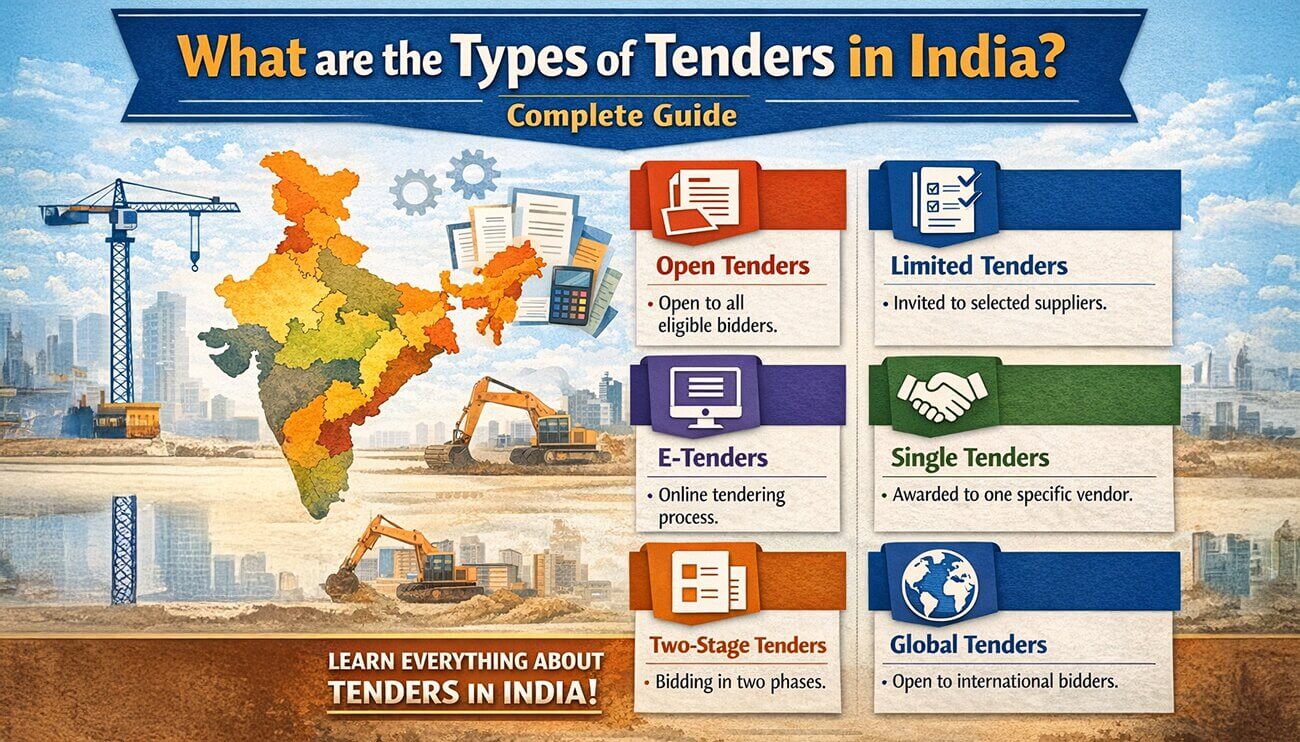
Government projects in India, from building highways and railways to supplying equipment or providing services, are usually awarded through a structured bidding process that is known as “Tendering.” If you are a contractor, supplier, MSME or business that is looking to work with the government, understanding the types of tenders in India is actually important.
In this guide, we have explained different types of tenders that is used in procurement, and how tendering works in several sectors.
What is a Tender?
Tender is the formal invitation that is issued by the government authority, public sector organization or large private company. They invite vendors or contractors to submit proposals for completing a project or supplying goods and services.
Through this process, the authorities who issued the invitation evaluate the different bids based on price, technical capability, experience and compliance. The contract is then awarded to the bidder that meets the requirements and offer the best value. Tendering makes sure the transparency, competition and fair selection in government procurement.
Types of Tenders in Government
Government organizations in India use different tendering methods based on the size, urgency and nature of the project. The following are the types of tenders in India that are commonly used-
1. Open Tender
This tender is the most widely used and transparent form of tendering in India. In this method, the tender notice is publicly advertised so that any eligible contractor or supplier can participate. Government departments publish open tenders on official procurement portals and websites.
Since it is published online publicly, the opportunity is open to all qualified bidders. But it also creates high competition and ensures that the government receives the best price and service. Open tenders are usually used for-
- Infrastructure projects
- Public works contracts
- Large procurement projects
- Government service contracts
Most contractors and new businesses begin their journey with open tenders because there are fewer entry restrictions compared to other tender types.
2. Limited Tender
Another term is Limited Tender, that only issued to the selected group of suppliers or contractors. So, instead of inviting bids from the public, the procuring authority sends tender invitations to pre-approved vendors. Limited tender is generally used when-
- The project requires specialized expertise
- Only a few suppliers are available in the market
- The procurement value is relatively small
- Time is limited
Limited tenders help speed up the procurement process because the government already knows the potential suppliers capable of completing the project.
3. Single Tender
A single tender (also called a proprietary tender) is issued to only one supplier or contractor. This type of tender is generally used in special situations where competition is not possible.
Common situations where single tenders are used include:
- When only one manufacturer produces a specific product
- When spare parts are required for a specific machine
- When emergency procurement is needed
- When a project must continue with the same contractor
Although single tenders are less common, they are allowed under procurement rules when justified by technical or operational requirements.
4. Negotiated Tender
This one is a negotiated tender where the buyer directly negotiates terms, pricing, or conditions with one or more suppliers. So instead of conducting a fully competitive bidding process. Negotiated tender is usually applied in complicated projects where detailed discussions are required before finalizing the contract. That is the reason these tender used for-
- Highly specialized engineering projects
- Strategic government procurements
- Urgent infrastructure work
5 Types of Tender in Procurement
In procurement and supply chain management, tenders can also be categorized based on how bids are evaluated and structured. The 5 types of tender in procurement generally include the following approaches.
Open Tendering
This method allows maximum competition because any qualified vendor can participate.
Selective Tendering
Only shortlisted suppliers are invited to submit bids based on prequalification criteria.
Negotiated Tendering
The buyer negotiates contract terms with a specific supplier or a limited group of suppliers.
Two-Stage Tendering
This method is commonly used in large infrastructure projects. In the first stage, technical proposals are evaluated. In the second stage, financial bids are considered.
Single-Source Tendering
Only one supplier is invited to submit a bid due to proprietary technology or lack of alternatives.
These procurement methods help organizations choose vendors efficiently depending on project complexity and urgency.
Types of Tender in Estimation and Costing
In construction planning and project budgeting, tendering methods are closely linked with estimation and costing strategies.
The types of tender in estimation and costing mainly include:
- Item Rate Tender
- Percentage Rate Tender
- Lump Sum Tender
- Cost Plus Tender
Each method influences how project costs are calculated, quoted, and controlled during execution.
For example, item rate tenders require detailed quantity estimation, while lump sum tenders require precise project planning before bidding.
Final Words
Understanding the tenders plays an important role if you want to participate or want to work with government authorities. There are several kinds of tenders, including open, limited, single, and negotiated. Each works differently, so make sure you participate where your business is more suitable. For exploring the active tenders across the nation or city wise at Tendershark, without any charges, so you can browse free of cost!