Everything to Know about RA (Reverse Auction)
Government procurement in India has become more transparent since the competition is real. Digital platforms like GeM (Government e-Marketplace) use one of the important methods to get the best price from bidders, which is the Reverse Auction (RA). Many people know this term, but do not understand it completely. So in this guide, we have made it simpler for anyone who wants to participate in a Reverse Auction in the GeM portal. We have mentioned everything about the RA meaning, types, process, GeM process and many more things. Read the complete blog to master this method!
What is a Reverse Auction?
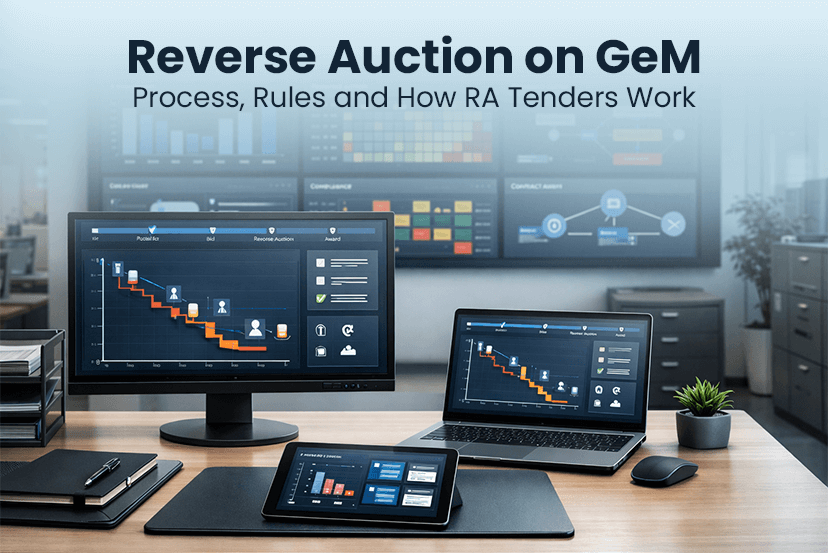
A reverse auction is the bidding process where multiple bidders compete by lowering their prices to win the tender contract. Unlike the normal auction, where buyers increase their bids, in RA, bidders can decrease their quoted price stepwise.
Moreover, the tender sets eligibility criteria and sellers or potential bidders can participate directly in the live event. Whoever among the participating businesses or companies offers the lowest acceptable price within the defined rules usually wins the contract.
Reverse Auction Meaning is that sellers (participating company, business, or individual) are allowed to decrease the quoted price for winning the project.
Where this method is used – Reverse Auction in India
In India, the RA method is commonly used in:
- Government procurement
- PSU purchases
- GeM portal buying
- Large corporate sourcing
- Infrastructure and service contracts
The reason GeM uses this method is to ensure fair competition, transparency, and cost savings for government authorities.
What are Reverse Auction Types?
RA can be conducted in different formats that completely depend on the procurement needs:
Open Reverse Auction
This one is open to all the qualified bidders. The purpose of an open reverse auction is to see the current lowest bid price (not bidder names or reputation). Bidders can continuously lower the price during the auction window. This format is commonly used when the supplier base is large.
Closed Reverse Auction
This one is completely different from the open RA, because closed reverse auctions only invite selected or shortlisted vendors to participate. That is the reason it is generally used when specialized products or limited suppliers are available.
Rank-Based Reverse Auction
Bidders see their ranking as L1, L2, L3 instead of exact prices and try to improve their position based on this. It is commonly used when price confidentiality is required, but competition is also needed.
Read More: Difference Between L1, L2 and L3 Tenders and Procurement | TenderShark
Multi-Round Reverse Auction
Now, this format of Reverse Auction includes when the auction is conducted in multiple phases with revised price opportunities. This is used when the high value or strategic procurement is involved.
How Reverse Auction Works?
The Reverse Auction specifically follows the structured process-
Requirement and Specifications
In this, the buyer clearly defines the project (Service or process) requirement, like quantity, quality standards, and delivery terms.
Eligible Vendors Are Shortlisted
The potential businesses will submit their bid and required documents. Afterwards, the buyer checks whether they meet technical and eligibility criteria like certifications, experience, and compliance requirements. The shortlisted participants move forward for further processing.
Base Price or Starting Bid Is Set
Before the live auction, a starting price is fixed in the system. This is usually based on the lowest qualified price received earlier or the estimated procurement value. On this point, bidders can only quote lower prices.
Event Is Scheduled
Next, all the qualified receive the full details about the auction window, including the date and time. Also, this information includes the price reduction amount, and the bidding rules so the bidder can prepare early.
Bidders Log in at Auction Time
Now, at the scheduled time, qualified bidders MUST log into the portal to participate in the live auction. By any chance, if bidders miss the auction window, they lose the opportunity to revise their price and compete further.
Reducing Prices
In the live auction, bidders are allowed to compete by lowering their quoted price step by step. Each new bid must be lower than the current lowest bid.
The best part is that the bidder can update their price multiple times within the allowed time.
System Updates Lowest Bid Live
The system automatically shows the latest lowest bid or rank live. This actually helps sellers to understand the competition level and decide whether to make any changes in their quoted price.
Auction Closes at Deadline
When the auction time ends, the system stops accepting new bids. But if anyone places the bid at the last moment around the closing time, then the system will automatically extend. This is important for fair competition.
Lowest Bidder Wins
After the auction closes, the lowest bid is finalized, but the award still depends on the compliance check and approval. If the conditions match, the contract will be issued to that win bidder.
How Reverse Auction Works in GeM – Step by Step
The following are the Reverse Auctions in the GeM portal-
Step 1 – Bid Creation
It starts from the government authorities, or the buyer creates the bid on GeM with details including-
- Product or service details
- Technical specifications
- Quantity
- Delivery terms
- Eligibility criteria
Step 2 – Technical Evaluation
Next, the potential bidder will submit a bid with technical details, and reviewed by the authorities-
- Documents
- Certifications
- Compliance
- Experience criteria
Only the technically qualified bidder is allowed to move to the RA stage.
Step 3 – RA Invitation
The qualified bidder will receive the “Reverse Auction Invitation” with complete details –
- RA date and time
- Duration
- Starting price
- Minimum decrement value
Step 4 – Reverse Auction Live Event
During the auction, here’s what happens-
- Sellers log into GeM
- See the current lowest bid
- Reduce their price strategically
- Bid multiple times within the allowed limits
The best part is that if the bid is placed near closing time, the system may auto extend the auction to allow fair competition.
Step 5 – Auction Close
When the time ends, the lowest price becomes the L1, then the buyer verifies compliance and the order is awarded.
Learn More GeM bidding Methods: Types of Bidding Methods on GeM Portal: Direct, L1, BOQ, RA | TenderShark
What are the RA Rules?
Reverse auctions comply with strict rules to ensure fairness:
Eligibility Rules: Only technically qualified bidders can participate, and the documents must be approved first.
Price Rules
- Each new bid must be lower than the current lowest.
- The minimum decreased value is predefined.
- No price increase allowed.
Time Rules
- Fixed auction duration
- Auto-extension if bids come at the last minute
- Late entries not accepted
Participation Rules
- Bidders must remain logged in
- Proxy bidding is not allowed unless the system is enabled.
- Manual interference is restricted
Compliance Rules
- The lowest bidder must still meet technical and contractual conditions
- The buyer can reject separately low bids if unjustified
Reverse Auction vs. Tender – Understanding the Difference
Many people confuse reverse auctions with tenders. A reverse auction is actually a pricing stage within certain tenders. This is not always a separate process.
| Difference Between Reverse Auction and Tender | ||
| Factor | Reverse Auction | Tender |
| Process Type | Live price competition | Formal bid submission |
| Price Movement | Prices go downward | Prices are quoted once |
| Interaction | Real time bidding | No live competition |
| Stages | It happened after the technical qualification | It include full procurement cycle |
| Transparency | Dynamic and visible price changes | Static price quotes |
| Speed | Faster price clarification | Slow evaluation |
| Usage | Price optimization | Vendor selection and contracting |
Tip: Find the most active tenders on a regular basis on TenderShark, where you can find the government tenders, e-tendering guide, and more information in a simple. While this platform allows you to do free searches so you can find the tenders that fit perfectly with your business.
Final Thoughts
Reverse auctions on GeM are made to bring maximum transparency, competition, and cost efficiency into government projects. For businesses and companies, understanding the RA process is really important to avoid the last minute panic and protect profit margins. While for tenders, RA helps to ensure they receive the best possible value.