What is a GeM Portal?
The government e-Marketplace (GeM) is the digital procurement platform launched by the Ministry of Commerce and Industry of India on August 9, 2016. It enables authorities or organisations to procure goods and services online with predefined rules that remove the manual tendering delays.
- Central and State Government departments
- PSUs
- Autonomous bodies
- Local authorities
While, for sellers, GeM offers:
- Direct access to government buyers
- Transparent evaluation
- Faster order processing
- Reduced intermediaries
Understanding the Bidding Method on GeM portal
The GeM portal allows aspiring or potential bidders to participate in the e-tendering process. It explains:
- How buyers invite offers
- How sellers compete
- How prices are discovered
- How winners are selected
Government e-commerce marketplace bidding method is not optional, it is mandatory based on the order value, complexity and procurement rules.
If you end up choosing the wrong bidding method or misunderstanding rules can cause technical rejection, price mismatch, or disqualification despite a lower price.
Common Types of Bidding Methods on the GeM Portal
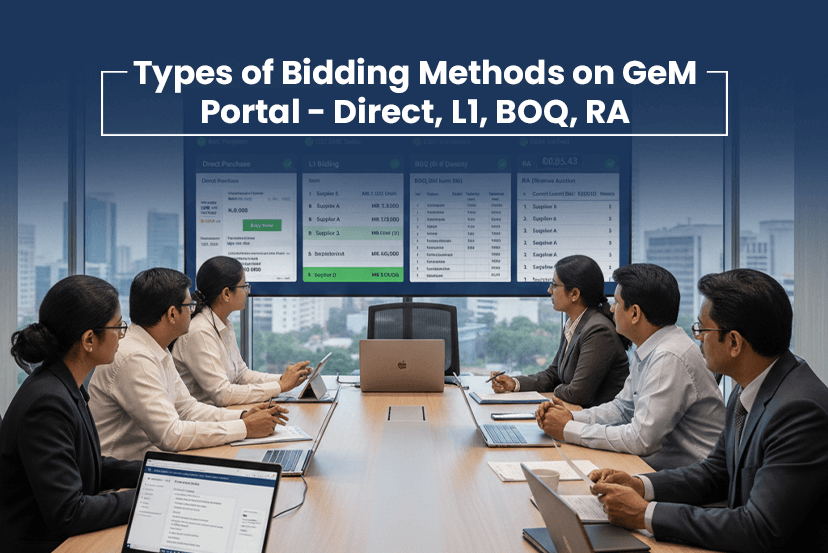
Till now, GeM supports four primary procurement methods, which include – Direct, L1, BOQ, and RA. Let’s understand each one:
Direct Purchase Method on GeM
Direct purchase is the buying method on GeM. In this, government buyers can directly place an order with a seller without needing to release or publish tenders.
The buyer selects the product or service listed on GeM, and compares available sellers, and places the order directly at the listed price.
Eligibility Criteria and Order Value Limits
Direct purchase on GeM is allowed only within specific financial limits and conditions:
- The order value must be within the “Direct Purchase”, as defined by GeM and government procurement rules.
- Buyers must ensure:
>> Reasonable pricing (L1 comparison or market reasonability).
>> Quality and specifications match their requirements.
- Usually, for higher values, GeM mandates L1 bidding or Reverse auction, not Direct purchase.
- Seller must:
>> Have active GeM registration.
>> List products/ services with approved specifications and pricing.
Note: The exact value limits may change as per government guidelines, so buyers and sellers should always check the latest GeM norms.
When Buyers Prefer Direct Purchase
Buyer generally choose Direct Purchase in situations like:
- When the buyer required urgent procurement.
- The order is small to medium.
- The item is basic and easily available.
- There is limited time to release or conduct bidding or RA.
- The buyer already finds the technically suitable and competitive seller that is pricely.
In a simple way, Direct purchase is mostly preferred when speed and simplicity matter more than price and competition.
Benefits for Sellers
Direct purchase offers several advantages to the sellers, like
- Faster order processing, no longer bidding cycle.
- No price competition like usually the case in the L1 or reverse auction.
- Better profit margins compared to aggressive RA.
- Suitable option for MSMEs and small sellers.
- Higher chances of repeat orders from satisfied buyers.
Direct purchase is a simple method to get GeM orders for many sellers, especially at the early stages.
Limitations and Risks
While there are several benefits, but it also has some limitations:
- Direct purchase comes in limited order value compared to the bids or RA.
- Buyers have many options available, so it is not necessarily you who gets the deal.
- Your price is reasonable but the buyer might reject it for any other reason.
- Low visibility if product listing is poor.
- Risk of order cancellation if the specifications don’t match exactly.
L1 (Lowest Price) Bidding Method
This method is one of the commonly used procurement methods on the GeM. Because it focuses on choosing the lowest priced eligible bidder after evaluating the technical and financial eligibility.
In simple, the contract or order is awarded to the seller who meets all the technical and eligibility requirements and quotes the lowest price (L1) among other qualified or participating bidders.
How Does L1 Evaluation Work?
L1 Bidding process on GeM follows a complete well structured evaluation process:
- Bid released by Tender/Buyer with requirements, specifications, quantity, timelines, and eligibility mentioned.
- Now the potential sellers submit the technical details and price quotes.
- Technical Evaluation, buyer check:
>> Product/ Service specifications.
>> Certifications and documents.
>> Eligibility criteria
- Now if the bidder is qualified for the technical requirement, they will be eligible for financial bid.
- The lowest quoted price among qualified bidders is marked as L1.
- The buyer places an order with the L1 bidder.
Pros and Cons for Bidders in the L1 Method
| Pros | Cons |
| Fair and transparent selection | Huge price competition |
| Equal opportunity for all eligible sellers or bidders | Low profit margins |
| Simple evaluation logic | High risk of underpricing |
| Suitable for standardized products | Technic rejection nullifies the low price advantage. |
Common Reasons for L1 Bid Rejection
While the price may lowest, but your bid still can be rejected if:
- If there are any mismatches in the specifications.
- Incorrect or missing documents.
- Your application is not complying with eligibility criteria.
- If the price seems unrealistically low.
- If you mentioned the timeline of the project that is not matching with bid terms.
BOQ (Bill of Quantity) Based Bidding on GeM
BOQ is used on the GeM portal when procurement involves multiple items, services or complex scope of work. Instead of quoting a single price the bidders must quote the entire item wise rates in BOQ format.
In details, the BOQ bidding on GeM:
- The buyer provides a Bill of Quantity (BOQ)
- The BOQ must contains:
>> Item descriptions
>> Units of measurements
>> Estimated quantities.
- Seller quote rates against each item.
- The overall bid value is auto calculated by the system.
The final evaluation is based on the overall BOQ total, not just a single item price.
When BOQ Bids Are Used
BOQ bids are usually used when:
- Procurement involves multiple line items.
- Services include varied components or activities.
- Custom or non standard specifications are involved.
- Project based or turnkey works are required
For example, IT infrastructure projects, Facility management, or manpower services, and others.
What is the Structure of BOQ Sheets?
The standard BOQ sheet usually includes:
- Item serial number
- Detailed item description
- Unit of measurement
- Quantity
- Unit rate
- Total amount
Note: Sellers can only fill the rate column. Editing the description or quantities is not allowed.
How Price Calculation and Evaluation work in BOQ
The Price evaluation in the BOQ bidding includes:
- Seller enters unit rates for each BOQ item.
- GeM system calculates based on:
- Item wise total = Quantity x Unit Rate
- Grand Total = Sum of all item totals
- Only technically qualified bidders are eligible for further process.
- The bidder with the lowest total BOQ value (L1) is selected.
Important: If one item is priced low compared to others, still the complete evaluation still depends on the overall BOQ total.
Challenges Bidders Face in BOQ Bids
BOQ seems a bit complicated, and many bidders find it challenging because:
- Complicated process because of each item’s descriptions.
- Risk of calculation errors
- High impact of one wrong rate.
- Low margins because of L1 competition.
- Might include hidden costs like taxes, logistics, and manpower.
Reverse Auction (RA)
The RA is an online bidding event where the buyer specifies the requirement and eligibility criteria. It only lets the technically qualified bidders participate. It performs just like an auction, but in a digital way:
>> Sellers can reduce their prices within a fixed time window.
>> The lowest price at closure becomes L1 as usual.
In RA, the prices move downward instead of upward.
How the RA Process Works?
The following are the steps including in the reverse auction:
- Tender Release: Buyer publishes the bid with RA option on GeM.
- Technical Evaluation: Only the eligible businesses can participate in the bid.
- RA invitation: The qualified bidder will now receive the auction date and time.
- Auction Starts: The system first shows the lowest quoted price (L1) from all the financial bids.
- Live Bidding: The seller can only lower their prices step by step by a fixed amount, not randomly.
- Auction Closes: Mostly lowest price becomes the final L1.
- Order placement: Buyer awards order to the L1 Seller.
The Eligibility and Participation Criteria
If you want to participate in the reverse auction on GeM, then understanding the proper eligibility and participation criteria:
- Seller must be technically required
- The participants must comply with:
- Bid specifications.
- Eligibility conditions.
- GeM seller policies.
- Sellers must be available online during RA time, and reduce the price only by the allowed decrement values.
Advantages for Buyers and Sellers of Reverse Auction
The following are the RA auctions for buyers and sellers:
| RA Benefit For Buyer | RA benefit For Sellers |
| Maximum price reduction | Equal opportunity after technical qualification. |
| No hidden costs and a competitive process | There are chances to win even if not initially L1 |
| The best lowest price is found quickly compared to others. | Quick finalization of orders, no longer processed. |
| Better value for public funds | Clear visibility of competition. |
How to Decide the Right Bidding Method on GeM?
Now you have clarity of all the bidding methods, so finding the right one completely depends on your business or services. The right bidding method on the Government e-commerce marketplace also relies on order value, urgency, and complexity.
>> Direct purchase usually happens for low value urgent needs.
>> L1 Bidding for clear and standard requirements.
>> BOQ bidding for complex or multi item work.
>> Reverse auction (RA) for high value procurement where maximum price competition is required.
7 Easy Steps to Follow to Bid on the GeM Portal
Bidding on the GeM portal online is simple if you follow the process correctly:
STEP 1: Register as a Seller on GeM
To start, register yourself as a seller on the GeM portal using your PAN, Adhaar, Bank Details, and Business information.
STEP 2: Complete Profile and Verification
Now, complete your profile by filling in all the required company details, uploading the required documents, and completing the verification part to become eligible for bidding.
STEP 3: List Your Products or Services
Add your products and services listing correctly, with proper specifications, pricing, GST details, and delivery timelines.
STEP 4: Search and Select Relevant Bids
You can simply start your search by using categories, and filters. Once you find the suitable tenders, make sure to read the tender document carefully. Especially, check the eligibility criteria, technical specifications, quantity, delivery location, and timelines before participating.
STEP 5: Submit Technical and Financial Details
Upload your documents and quote your price on the basis of the bid format, like L1, BOQ, RA.
STEP 6: Track Status
After bidding, you can track technical evaluation status, financial bid opening, or reverse auction schedules on your dashboard on GeM.
STEP 7: Receive Order
If you win the tender contract, accept the order and delivery as per the terms. Upload the complete required documents for payments.
Final Thoughts
Understanding the types of bidding methods on the GeM portal will allow you to confidently bid in every method. This confidence boosts your chances of winning the contract. In this blog, we mentioned everything about the types of bid methods, including L1, Direct, BOQ, and RA, with each process and definition. From these takeaways, bid properly and increase your chance of getting the tender contract!