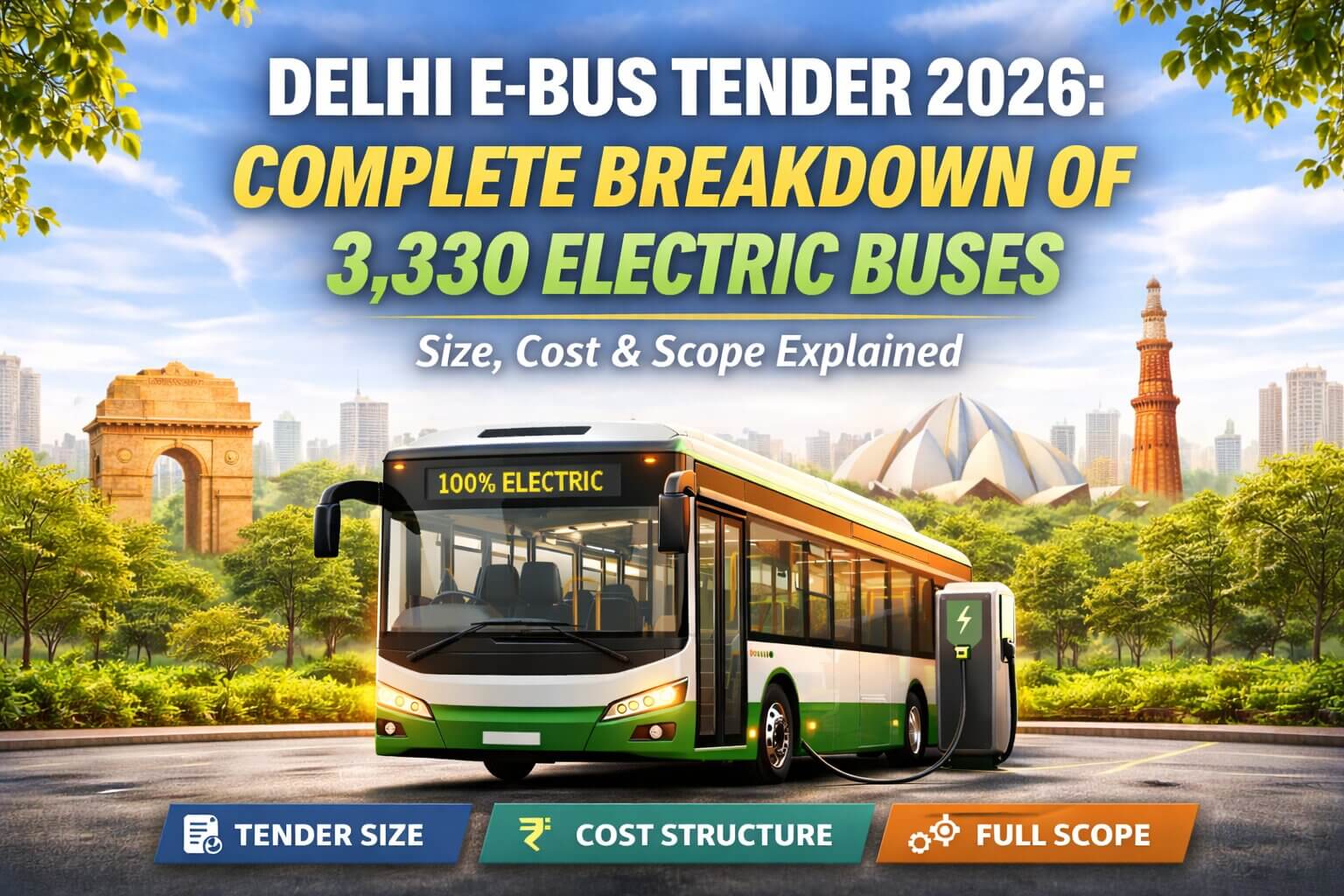
Delhi has announced one of the largest electric bus tenders in India in 2026, with a massive plan to deploy 3,330 e-buses across the city. This move is a major step toward 100% electric public transport and positions Delhi as a leader in clean mobility.
In this article, we provide a complete breakdown of the Delhi e-bus tender 2026, including tender size, cost structure, scope, and future impact.
Delhi E-Bus Tender 2026 Overview
- Total buses: 3,330 electric buses
- Tender model: Gross Cost Contract (GCC)
- Execution agency: Convergence Energy Services Limited
- Objective: Expand fleet + improve last-mile connectivity
This is one of the biggest city-level e-bus tenders in India.
Fleet Size Breakdown (3,330 E-Buses Explained)
Delhi is not just adding buses—it is building a smart, route-based fleet system.
Bus-wise distribution:
- 500 mini buses (7m)
- 2,330 medium buses (9m)
- 500 standard buses (12m)
Why this matters:
- Small buses → narrow lanes & colonies
- Medium buses → feeder & urban routes
- Large buses → high-demand corridors
This multi-size strategy improves efficiency, coverage, and passenger convenience.
Cost Structure: How Delhi Pays for E-Buses
The Delhi e-bus tender follows a GCC (Gross Cost Contract) model, which is key to understanding the cost.
Payment model:
- Government pays per km cost
- Contract duration: 10–12 years
- No upfront purchase cost
Private operator responsibilities:
- Buy buses
- Maintain fleet
- Set up charging infrastructure
This reduces government risk and ensures long-term service reliability.
Scope of the Tender: What’s Included?
This is not just a bus procurement—it’s a complete transport solution.
Tender scope includes:
- Electric bus supply
- Charging infrastructure setup
- Depot electrification and upgrades
- Operations and maintenance
- Workforce and service management
Delhi is adopting an end-to-end execution model, ensuring faster rollout and accountability.
Why Delhi’s E-Bus Tender Is Important
1. Pollution Reduction
Electric buses will significantly reduce emissions in one of India’s most polluted cities.
2. Public Transport Expansion
More buses mean improved frequency and reduced wait times.
3. Better Connectivity
Focus on feeder routes and last-mile access.
4. Scalable Model
Can be replicated across other Indian cities.
Impact on Delhi’s Transport System
Current scenario (2026):
- 3,500+ electric buses already running
- Total fleet: 5,000+ buses
After tender execution:
- 7,000+ electric buses expected
- Majority of fleet becomes electric
Delhi is moving toward a fully electric bus ecosystem.
Key Challenges in Implementation
Despite strong planning, some challenges remain:
Charging Infrastructure
Needs to scale at the same pace as buses
Depot Readiness
Urban land constraints can delay projects
Financial Pressure
Low bid pricing may affect operators
Execution Delays
Coordination across agencies is critical
Future Outlook: What Happens Next?
Delhi’s e-bus tender 2026 is just the beginning.
Expected trends:
- Expansion to more routes and areas
- Increase in feeder and mini buses
- Smart fleet management systems
- Integration with metro and multimodal transport
Delhi is on track to become India’s first fully electric public transport city.
Final Words
The Delhi e-bus tender 2026 (3,330 buses) is not just about numbers—it represents a major shift in how public transport is planned and operated.
With:
- Large-scale deployment
- Smart fleet segmentation
- Sustainable financial model
Delhi is setting a benchmark for electric mobility in India.
In this article, we provide a complete breakdown of the Delhi e-bus tender 2026, including tender size, cost structure, scope, and future impact.
Delhi E-Bus Tender 2026 Overview
- Total buses: 3,330 electric buses
- Tender model: Gross Cost Contract (GCC)
- Execution agency: Convergence Energy Services Limited
- Objective: Expand fleet + improve last-mile connectivity
This is one of the biggest city-level e-bus tenders in India.
Fleet Size Breakdown (3,330 E-Buses Explained)
Delhi is not just adding buses—it is building a smart, route-based fleet system.
Bus-wise distribution:
- 500 mini buses (7m)
- 2,330 medium buses (9m)
- 500 standard buses (12m)
Why this matters:
- Small buses → narrow lanes & colonies
- Medium buses → feeder & urban routes
- Large buses → high-demand corridors
This multi-size strategy improves efficiency, coverage, and passenger convenience.
Cost Structure: How Delhi Pays for E-Buses
The Delhi e-bus tender follows a GCC (Gross Cost Contract) model, which is key to understanding the cost.
Payment model:
- The government pays per km cost
- Contract duration: 10–12 years
- No upfront purchase cost
Private operator responsibilities:
- Buy buses
- Maintain fleet
- Set up charging infrastructure
This reduces government risk and ensures long-term service reliability.
Scope of the Tender: What’s Included?
This is not just a bus procurement—it’s a complete transport solution.
Tender scope includes:
- Electric bus supply
- Charging infrastructure setup
- Depot electrification and upgrades
- Operations and maintenance
- Workforce and service management
Delhi is adopting an end-to-end execution model, ensuring faster rollout and accountability.
Why Delhi’s E-Bus Tender Is Important
1. Pollution Reduction
Electric buses will significantly reduce emissions in one of India’s most polluted cities.
2. Public Transport Expansion
More buses mean improved frequency and reduced wait times.
3. Better Connectivity
Focus on feeder routes and last-mile access.
4. Scalable Model
Can be replicated across other Indian cities.
Impact on Delhi’s Transport System
Current scenario (2026):
- 3,500+ electric buses already running
- Total fleet: 5,000+ buses
After tender execution:
- 7,000+ electric buses expected
- Majority of fleet becomes electric
Delhi is moving toward a fully electric bus ecosystem.
Key Challenges in Implementation
Despite strong planning, some challenges remain:
Charging Infrastructure
Needs to scale at the same pace as buses
Depot Readiness
Urban land constraints can delay projects
Financial Pressure
Low bid pricing may affect operators
Execution Delays
Coordination across agencies is critical
Future Outlook: What Happens Next?
Delhi’s e-bus tender 2026 is just the beginning.
Expected trends:
- Expansion to more routes and areas
- Increase in feeder and mini buses
- Smart fleet management systems
- Integration with metro and multimodal transport
Delhi is on track to become India’s first fully electric public transport city.
Final Words
The Delhi e-bus tender 2026 (3,330 buses) is not just about numbers—it represents a major shift in how public transport is planned and operated.
With:
- Large-scale deployment
- Smart fleet segmentation
- Sustainable financial model
Delhi is setting a benchmark for electric mobility in India.