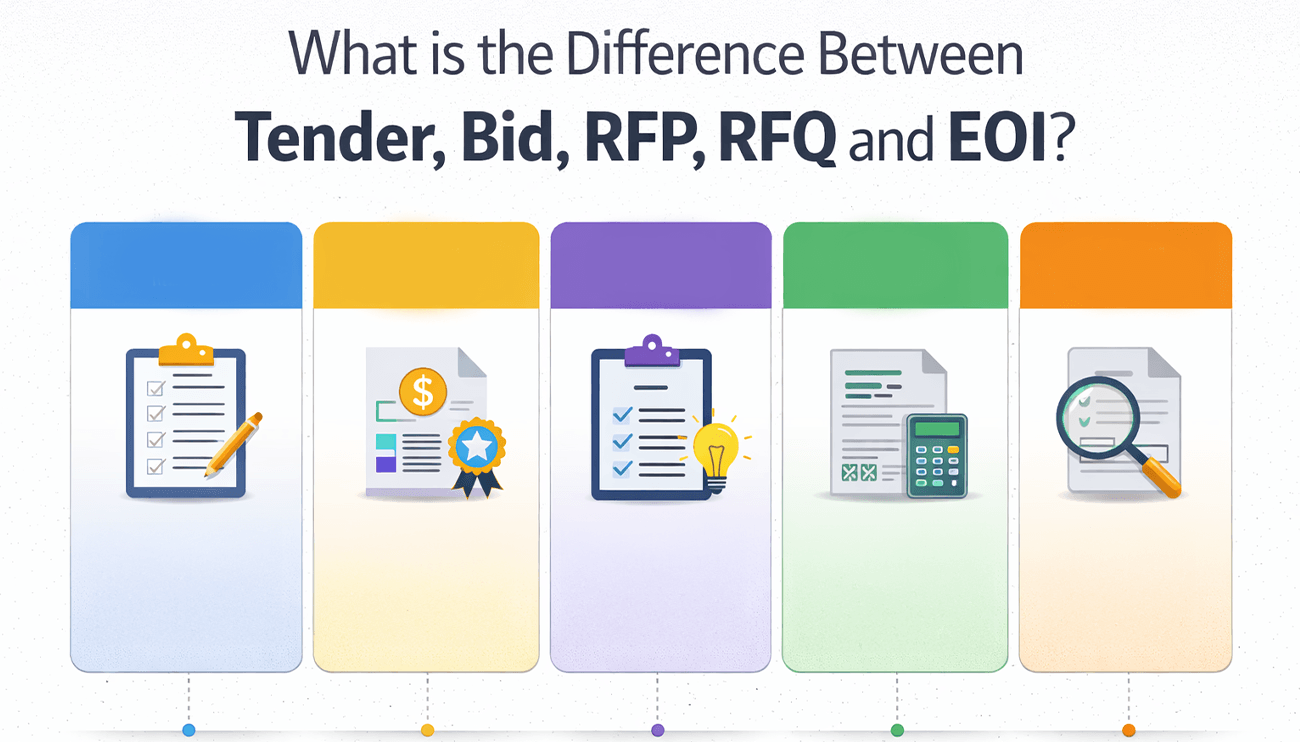
Do you want to participate in private or government procurement? So you must have seen terms like Tender, Bid, RFP, RFQ, EOI and even RFI. Whether you are a professional or a beginner, understanding these terms helps you find the right tender by following the complete purpose in the procurement cycle. If you understand the difference between tender, RFP, RFQ and EOI, it will allow you to apply for contracts, submit proposals correctly and improve your chance of winning projects.
This comprehensive guide covered everything that you must know about these terms. Read completely to have a proper understanding.
What are the Basics of Procurement?
Lets start by having clear knowledge of how these terms are used in procurement systems. Usually, these terms are used in the government procurement process for transparency, competition, and value for money. The process usually starts with gathering information (RFI/EOI), followed by a detailed proposal (RFP), price quotations (RFQ) and finally issuing the tender where vendors can submit bids.
Learn More: Difference Between L1, L2 and L3 Tenders and Procurement | TenderShark
What is a Tender?
A tender is an official invitation issued by a government department or private organization asking suppliers or contractors to submit their offers for a project, service, or supply of goods.
It is a formal and legally structured document that includes-
>> Project details
>> Eligibility criteria
>> Technical requirements
>> Submission guidelines.
In simple terms, a tender is the complete opportunity or project announcement where vendors participate. It is commonly released throughout the GeM eprocurement platform.
What is a Bid?
This term used to refer to a response submitted by the vendor or contractor against a tender. Bid includes all the required documents, like-
>> Technical specifications
>> Pricing details
>> Company profile
>> Compliance certificates.
While the tender is the invitation, a bid is the actual offer made by the participant or businesses.
In simple-
>> Tender: Opportunity
>> Bid: Your response to that opportunity.
What is an EOI?
EOI is an Expression of Interest, which is the initial stage of procurement. In this process, the buyer wants to understand who is interested and capable of handling a project.
This step does not need a detailed pricing or technical proposal. It only focuses on gathering basic information about vendors like experience, capability and interest level.
Difference between EOI and Tender
The difference between EOI and tender lies in their purpose and depth:
>> EOI is exploratory and used for shortlisting vendors
>> Tender is detailed and used for final selection.
Basically, an EOI helps organizations to filter potential bidders before issuing a full tender.
What is an RFI?
The Request for Information (RFI) is used even before EOI in some cases. It is another initial step where organizations collect general information about the market, technologies, or available solutions.
This does not involve selection or bidding. Instead, this helps the buyer understand what options exist before creating formal requirements.
What is an RFP?
RFP full form is Request for Proposal. In tender, RFP is the detailed document where the buyer (Authorities), as the participants, submit a complete proposal including technical approach, methodology and pricing.
This is mainly used when the project is complicated and news innovation or customized solutions.
The common difference between EOI and RFP
>> EOI check interest and basic capability.
>> RFP evaluates detailed solutions and execution plans.
RFP is commonly used in IT services, consulting, infrastructure, and large scale projects.
What is an RFQ?
RFQ stands for Request for Quotation, which is used when the buyer knows exactly what they need and only wants price quotations from vendors.
RFQ does not need a detailed proposal or methodologies. It is purely focused on cost comparison.
Difference between Request for Tender and Request for Proposal
Many people get confused between RFT and RFP, but the difference is simple-
>> Request for Tender: It is more rigid and focuses on predefined specifications. Businesses compete mainly on compliance and pricing.
>> Request for Proposal: This is flexible and allows vendors to suggest their own approach, innovation and solutions.
In a simpler way, RFT is used when the requirement is fixed, while RFP is used when the buyer needs expertise and creative input.
Difference Between All Terms – In Simple
- RFI: Collects general information
- EOI: Identifies interested and capable vendors
- RFP: Requests detailed proposals
- RFQ: Asks for price quotations
- Tender: Official project invitation
- Bid: Vendor’s submission
What is the Role of TenderShark?
The platform where you can easily find the latest tenders of the authorities, states, and on a keyword basis. You can easily search unlimited without any disturbance. Tendershark is the platform where you can explore tenders from JKtenders, Bihar tender, UP, NHAI, Solar, and many more available here.
Sum Up
In tenders, these terms matter a lot, while each sounds complicated, but when you know the difference between Tender, Bid, RFP, RFQ, and EOI. Each stage has a specific purpose, from exploring the market to finalizing contract. If you are planning to enter the tendering process, you can start by understanding each term.