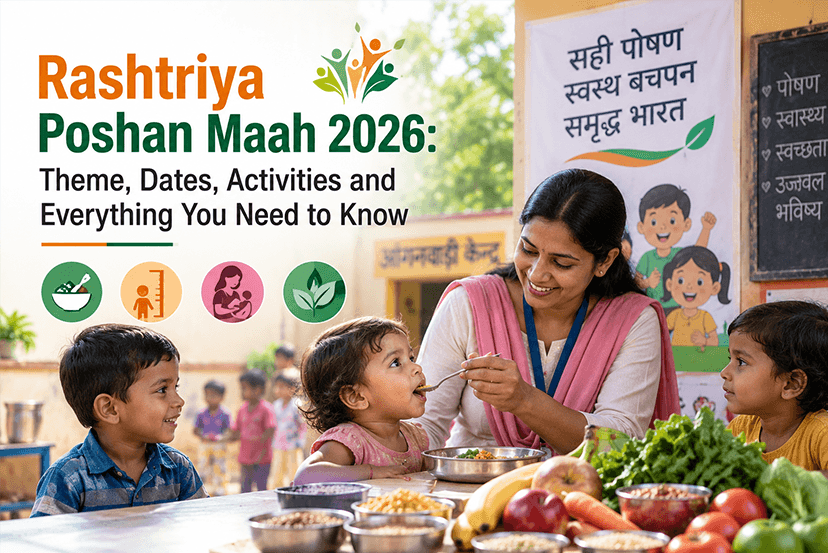
Nutrition is not only about having enough food, but it is also about eating the right variety of foods, receiving proper care and ensuring healthy growth from pregnancy through early childhood. With this focus, the Government of India observes Rashtriya Poshan Maah every year to create awareness about nutrition, maternal health, child development and healthy caregiving practices.
The Rashtriya Poshan Maah 2026 is specifically important because the campaign puts Anganwadi Centres at the centre of community participation. The ninth edition was launched on 9 September 2026 in Varanasi, Uttar Pradesh, under the theme “Humari Anganwadi, Humari Jimmedari.” We covered everything about this scheme in this guide.
What is Rashtriya Poshan Maah?
Rashtriya Poshan Maah, also known as National Nutrition Month. It is an annual nutrition awareness campaign observed every September. The goal is to bring nutrition-related issues into public discussion and encourage families, communities, Anganwadi workers and government agencies to take practical steps toward better nutrition.
The campaign is closely associated with Poshan Abhiyaan, which was launched in March 2018 as multi ministerial initiative to improve nutrition outcomes in India.
Rashtriya Poshan Maah campaign focuses particularly on-
- Pregnant women
- Lactating mothers
- Children
- Adolescents and their families.
Over time, this has evolved into a Jan Andolan that encourages community participation rather than limiting nutrition awareness to government programmes alone.
Official Link: 9th Rashtriya Poshan Maah
What are the Key Focus Areas of Poshan Maah 2026?
The 2026 campaign has been structured around five interconnected priorities.
1. Dietary Diversity and Adequate Protein
A healthy diet requires more than simply consuming sufficient calories. The campaign promotes dietary diversity by encouraging the consumption of different food groups, including cereals and millets, pulses, vegetables, fruits, nuts, seeds and milk and milk products.
Adequate protein is another major focus. Through demonstrations and awareness activities, communities will learn how affordable and locally available foods can be combined to provide better nutrition.
This approach is especially relevant for children, pregnant women and lactating mothers, whose nutritional requirements can change significantly during different stages of life.
Official Link: 9th Rashtriya Poshan Maah
2. Fresh Hot Cooked Meals at Anganwadi Centres
Another important focus is the availability and quality of fresh hot cooked meals through the Supplementary Nutrition Programme.
Anganwadi Centres will promote menu rotation using ingredients such as millets, pulses and seasonal vegetables. Live cooking demonstrations and community tasting activities are also planned to help families understand how nutritious meals can be prepared using locally available ingredients.
The revised Supplementary Nutrition Programme guidelines have also introduced provisions concerning Hot Cooked Meals and SNP Menu Boards, making information about meals and entitlements more visible at Anganwadi Centres.
Official Link: https://www.pib.gov.in/newsite/erelcontent.aspx?lang=2®=48&relid=294367
3. Community Ownership and Accountability
The theme of “Hamari Anganwadi, Hamari Jimmedari” is directly connected with this focus area.
Anganwadi Management Committees are expected to play a greater role in monitoring service delivery and encouraging community participation. As part of Poshan Maah 2026, Anganwadi Centres are expected to conduct committee meetings and strengthen community involvement.
Displaying SNP Menu Boards is another step towards transparency, as families can see what meals are planned and understand the nutrition services available at the centre.
4. Nutrition and Early Childhood Development
Nutrition and early learning are closely connected during the early years of a child’s life. Therefore, Poshan Maah 2026 also focuses on Early Childhood Care and Education (ECCE).
Anganwadi Centres will organise parent-child activities, early learning events and exposure visits for children approaching primary school age. Activities involving toys, play-based learning and community resources are intended to make early childhood development more engaging.
The broader message is simple: proper nutrition supports not only physical growth but also a child’s ability to learn and develop.
5. Ten Years of Pradhan Mantri Matru Vandana Yojana
The 2026 campaign also marks 10 years of the Pradhan Mantri Matru Vandana Yojana (PMMVY).
The focus is on maternal nutrition, healthcare-seeking behaviour and support available to eligible pregnant and lactating women. A saturation approach is being encouraged so that eligible beneficiaries can access the benefits and services available to them.
What Activities Will Be Conducted During Poshan Maah 2026?
The activities under Rashtriya Poshan Maah 2026 are designed to take nutrition awareness beyond posters and speeches and bring it into everyday community life.
- Anganwadi Centres will conduct nutrition demonstrations, Poshan Melas, community discussions, healthy recipe demonstrations and activities promoting protein-rich foods.
- Parents and community members can also participate in tasting sessions and discussions around freshly cooked meals.
- Early Childhood Care and Education activities will include parent-child interactions, learning activities and community-based events.
- Quiz competitions and information sessions may also be organised around nutrition, childcare and healthy practices.
- Community participation is particularly important this year. Anganwadi Management Committees, Mothers’ Committees, Panchayats and Self-Help Groups can contribute towards monitoring meal quality, menu adherence and the overall functioning of Anganwadi services.
What is the Role of Poshan Abhiyaan in Rashtriya Poshan Maah?
Poshan Abhiyaan provides the broader framework for community mobilisation and behavioural change around nutrition.
Launched in 2018, the initiative focuses on improving nutritional outcomes through convergence, technology, capacity building, community participation and behavioural change. Its approach recognises that malnutrition cannot be addressed through food supplementation alone; families also need awareness, healthcare support, appropriate childcare practices and access to nutrition-related services.
Today, these efforts operate within the broader Mission Saksham Anganwadi and Poshan 2.0 framework, which brings together nutrition and Anganwadi-related interventions.
How Does Technology Support Poshan Programmes?
Technology has become an important part of nutrition monitoring in India. The POSHAN Tracker is an ICT-based governance tool under Mission Saksham Anganwadi and Poshan 2.0. It supports near-real-time monitoring of Anganwadi activities and nutrition service delivery.
The platform supports the monitoring of beneficiaries and services and helps identify nutrition-related indicators among children. This makes digital monitoring an important part of improving accountability and tracking the delivery of services.
People searching for a Poshan Maah dashboard should also distinguish between campaign information and beneficiary/service monitoring platforms. A dashboard may provide programme or activity-related information, while tools such as POSHAN Tracker are specifically designed for monitoring Anganwadi services and beneficiaries.
Who Can Participate in Rashtriya Poshan Maah 2026?
Rashtriya Poshan Maah is designed as a community campaign, so participation is not limited to government officials. All of these can contribute to nutrition awareness-
- Anganwadi workers
- Parents
- Pregnant women
- Lactating mothers
- Children
- Adolescents
- Teachers
- Panchayat representatives
- Self-Help Groups
- Community organisations
The larger objective is to make nutrition a shared responsibility. This is also why the 2026 theme places the Anganwadi Centre at the heart of community action.
How Can You Find Authentic Poshan Maah Information?
With increasing online searches around Rashtriya Poshan, Poshan Abhiyaan, campaign dates, activities and dashboards, it is important to rely on official government sources for programme-related information.
The Ministry of Women and Child Development and the Press Information Bureau publish official announcements and updates related to Poshan Maah. For information related to Anganwadi service monitoring, the official POSHAN Tracker information provided by the Ministry is a useful reference.
This is especially useful because campaign themes, activities, guidelines and implementation details can change from one year to another.
Additionally, you can search for more informative guides on Tendershark that cover topics like the latest government based activities, tenders across India, and more.
Final Words
Rashtriya Poshan Maah 2026 brings the focus back to a simple but important idea: better nutrition requires collective effort. With “Hamari Anganwadi, Hamari Jimmedari” as its overarching theme, this year’s campaign gives greater importance to community participation, dietary diversity, adequate protein, fresh cooked meals, early childhood development and maternal nutrition.
The campaign also strengthens the connection between Poshan Abhiyaan, Anganwadi services and community-led action. For families, the most meaningful takeaway is not simply knowing the theme or dates but understanding how better food choices, maternal care, early childhood support and participation in local nutrition services can contribute to a healthier community.
As the campaign progresses, official updates from the Ministry of Women and Child Development should be followed for state-specific activities, guidelines and programme information.