Having a permanent home is a goal for millions of Indian families, but the cost of land, construction, and home loans can make it difficult for low- and middle-income households to achieve it. The Pradhan Mantri Awas Yojana (PMAY) is one of the Government of India’s major housing initiatives designed to improve access to affordable housing.
With the new approach of PMAY 2.0 or Awas 2.0, there is some latest information that people are still not aware. If you wish to own your house in 2026, then this guide will explain everything. If you have already applied or are planning to apply, this guide covers PMAY 2.0 eligibility, registration, PMAY 2.0 track application status, and different ways to use the official portal.
What is PMAY 2.0?
PMAY 2.0 or PM Awas Yojana 2.0, is the urban housing initiative of the Ministry of Housing and Urban Affairs (MoHUA). It aims to provide financial assistance to eligible urban households so they can construct, purchase or access affordable housing.
Under PMAY-U 2.0, assistance is provided through four verticals:
- Beneficiary-Led Construction (BLC): Financial assistance for eligible EWS families to construct a new pucca house on their own land.
- Affordable Housing in Partnership (AHP): Assistance for eligible EWS beneficiaries to purchase or own a pucca house in approved affordable housing projects.
- Affordable Rental Housing (ARH): affordable rental housing for eligible EWS and LIG households, including migrants, workers and other urban residents.
- Interest Subsidy Scheme (ISS): interest subsidy on eligible home loans for EWS, LIG and MIG households.
The official PMAY-U 2.0 portal states that BLC can provide assistance of up to Rs. 2.5 Lakh to eligible EWS families with annual household income up to Rs. 3 Lakh for constructing a new pucca house on available land.
Under AHP, eligible EWS beneficiaries can receive financial assistance towards purchasing an affordable house.
Official PMAY 2.0 Guidelines: PMAY-U 2.0 Scheme Guidelines
Who is Eligible for PMAY 2.0?
If you want to apply for the Pradhan Mantri Awas Yojana 2.0, then you should meet certain eligibility criteria that highly depend on the applicant’s location, household income, existing home ownership and the component under which the benefit is being sought.
The general PMAY-U 2.0 eligibility criteria is the category.
- Applicant should belong to (EWS, LIG or MIG) and live in an Urban area.
- The family should not own a pucca house anywhere in India in the name of the applicant or any member of the beneficiary family.
- The income categories are broadly defined as-
- EWS: Annual household income up to Rs. 3 lakh.
- LIG: Annual household income above Rs. 3 lakh and up to Rs. 6 lakh.
- MIG: Annual household income above Rs. 6 lakh and up to Rs. 9 lakh.
NOTE: States and Union Territories may have certain flexibility in defining income criteria for specific purposes, subject to the scheme guidelines.
IMPORTANT: Applicants should also note that simply submitting a PMAY 2.0 application does not guarantee assistance. The information submitted by the applicant must be verified by relevant
- State/UT
- Urban Local Body
- Implementing agency
- Central Nodal Agency
- Primary Lending Institution
These all depend on the selected component.
Who may receive preference under PMAY-U 2.0?
The scheme gives preference to several vulnerable groups, including widows, single women, persons with disabilities, senior citizens, transgender persons, members of Scheduled Castes and Scheduled Tribes, minorities and other weaker sections. Special focus is also given to groups such as Safai Karmis, street vendors identified under PMSVANidhi, artisans covered under PM Vishwakarma, Anganwadi workers, construction workers and residents of slums and chawls.
PMAY 2.0 Components – Understand Before Applying
There are four major components that everyone should understand before applying. Because you have to select the appropriate option according to your circumstances and eligibility.
1. Beneficiary Led Construction (BLC)
BLC is meant for eligible EWS families who have land available and want to construct a new pucca house.
- Under this component, eligible beneficiaries can construct an all-weather house with carpet area between 30 and 45 square metres. The assistance is linked to the progress of construction and the construction stages are geo-tagged for monitoring.
- Existing houses cannot simply be renovated or extended under BLC: the assistance is intended for construction of a new pucca house.
- Applicants can approach their Urban Local Body or implementing agency, or register their demand through the unified web portal with documents such as land ownership proof and other required information.
2. Affordable Housing in Partnership (AHP)
AHP is designed to help eligible EWS beneficiaries own affordable pucca houses developed through public or private agencies.
Under this component, affordable houses generally have a carpet area of 30–45 square metres. Eligible EWS beneficiaries can receive financial assistance towards the purchase price of an eligible house.
3. Affordable Rental Housing (ARH)
Not every household wants or is financially able to purchase a home. PMAY 2.0 therefore also includes an Affordable Rental Housing component.
ARH is intended to provide affordable and hygienic rental accommodation to eligible EWS and LIG households, including urban migrants, industrial workers, working women, construction workers and other urban poor groups.
4. Interest Subsidy Scheme (ISS)
ISS is specifically relevant to people planning to purchase, repurchase or construct a house using a home loan.
Under PMAY-U 2.0, eligible EWS, LIG and MIG households can receive an interest subsidy on qualifying home loans sanctioned and disbursed on or after 1 September 2024. The annual household income can be up to Rs. 9 lakh, while the maximum eligible housing loan is Rs. 25 lakh and the maximum house value is Rs. 35 lakh. The maximum actual interest subsidy is Rs. 1.80 lakh.
What Are the Documents Required for PMAY 2.0 Registration?
Before starting the registration process, keep your basic documents ready-
- Aadhaar Details
- Mobile number
- Income-related information (Statement, Payslip, etc.)
- Bank details
- Family information
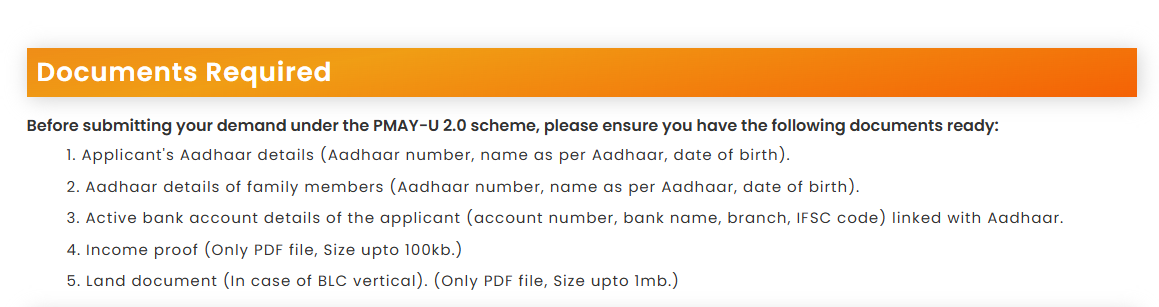
In the case of BLC, you should provide documents that prove ownership or right over the land.
Always go through: PMAY-U 2.0 Scheme Guidelines (Official government guidelines)
How to Apply for PMAY 2.0 Registration: Step By Step
The following are the steps you should go through to apply for PMAY 2.0 registration-
Step 1
Go to the official PMAY-U 2.0 website and select the option to apply under the scheme.
Step 2
Now, click on “Apply for PMAY-U 2.0.”
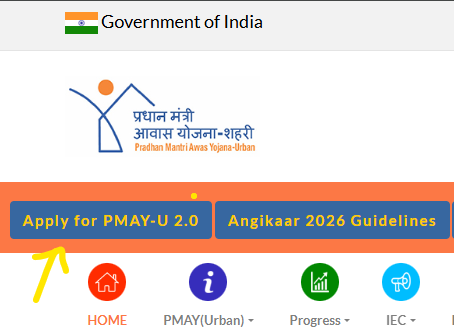
Step 3
Before applying for registration, it will show the proper instruction for user. So read that carefully then click on “Click to Proceed.”
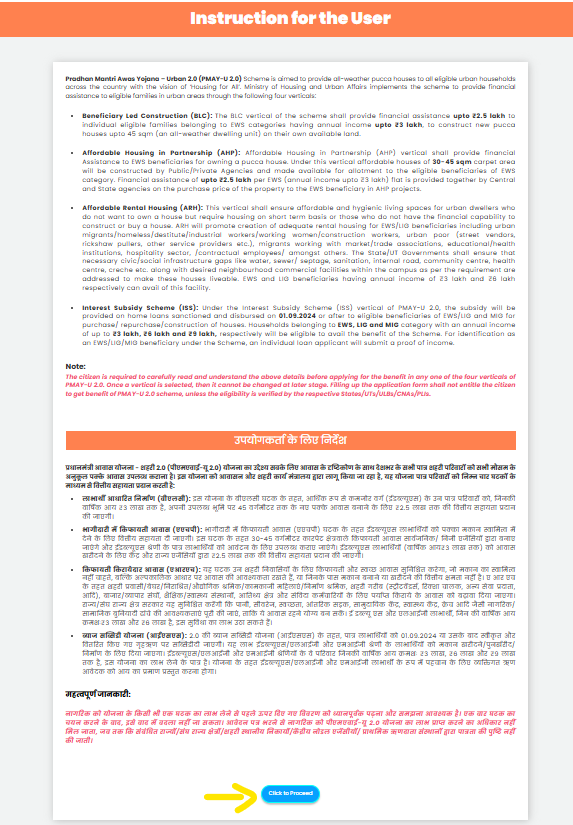
Note: When you click on “PMAY-U 2.0,” you may be redirected to the third party website, but you should come back to the official portal where it shows instructions for users.
Step 4
Next, it will show you the documents required to apply for Pradhan Mantri Awas Yojana 2.0. Click on “Proceed,” and you will get the form. (as shown in the screenshot below)
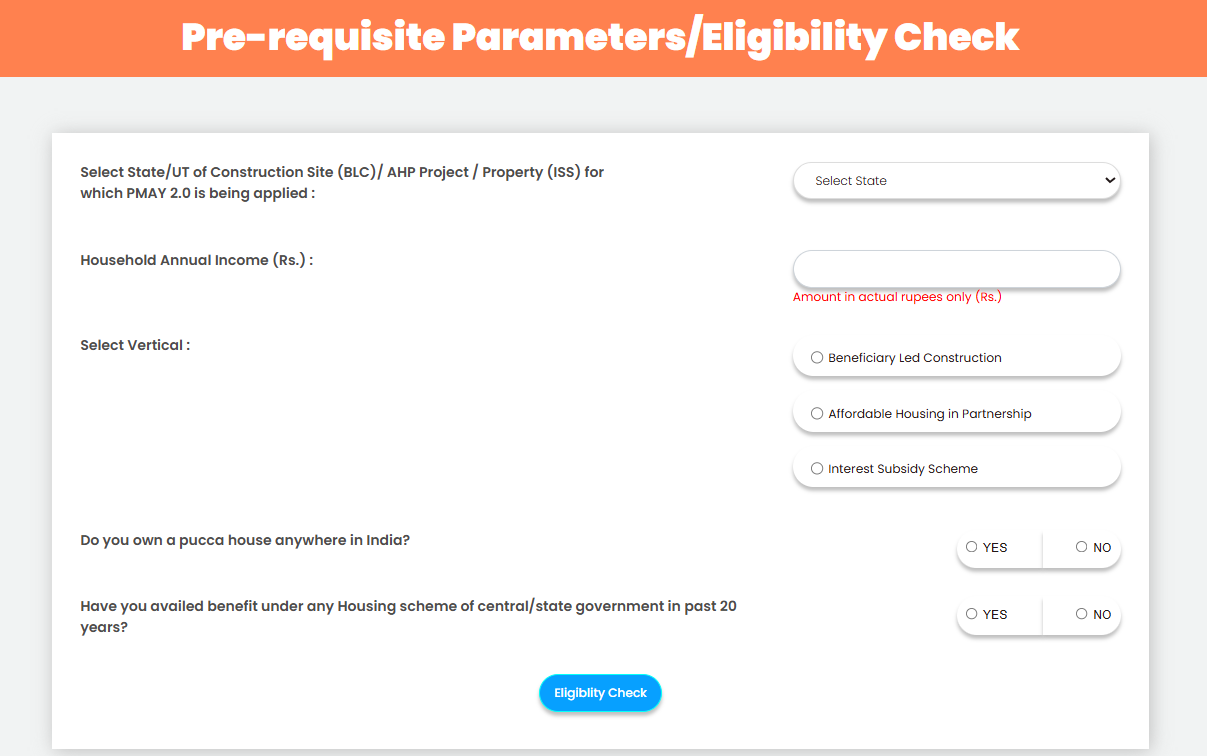
It is basically the pre-requisite parameters/ eligibility check; once you fulfill that you will be able to successfully apply for PMAY 2.0.
How to Check PMAY 2.0 Track Application Status?
If you have already submitted your application, you can use the official system to track PMAY 2.0 application status.
The PMAY-U 2.0 unified web portal has a facility for beneficiaries to track application status in real time.
To check your PMAY 2.0 application status, follow these steps:
- Visit the official PMAY-U 2.0 portal.
- Open the application/status tracking facility.
- Enter the details requested by the portal, such as your Application ID or other available identification details.
- Submit the information.
- Your application status and available progress details will be displayed.
For applicants under the Interest Subsidy Scheme, the system can provide information related to registration, due diligence, approval of the claim and subsidy release. The official FAQ states that ISS applicants can use their unique user code, Application ID or registered mobile number to check relevant application information through the unified web portal or mobile application.
Can You Apply for PMAY 2.0 If You Already Own a House?
Most of the people ask whether they can apply for Pradhan Mantri Awas Yojana even if they own a house.
Well, families who own a pucca house anywhere in India are not eligible for the housing ownership or construction benefits under PMAY-U 2.0.
The scheme defines a beneficiary family as the husband, wife, and unmarried sons or unmarried daughters and specifies that eligible urban families should NOT own a pucca house in the name of the applicant or any family member anywhere in India.
There are also additional exclusion conditions.
Let’s understand this by example-
The official PMAY-U 2.0 FAQs state that applicants who have availed benefits from a Central Government, State Government or Local Self Government housing scheme in the preceding 20 years are not eligible for PMAY-U 2.0.
PMAY 2.0 vs PMAY Gramin: What Is the Difference?
Another confusion is the difference between PMAY 2.0 and PMAY Gramin. Well, here is the difference-
PMAY-U 2.0
It is intended for eligible households in urban areas and is implemented by the Ministry of Housing and Urban Affairs.
PMAY Gramin (PMAY-G)
Pradhan Mantri Awas Yojana Gramin is the rural housing programme administered by the Ministry of Rural Development. Its objective and beneficiary identification process are different from PMAY-U 2.0.
PMAY-G offers services like a permanent wait list, instalment details and a facility to search IAY/PMAY-G beneficiary details.
What Should You Do If Your PMAY 2.0 Application Is Rejected or Pending?
If your PMAY 2.0 status shows that the application is pending, first check whether the authority has requested additional information, document verification or correction.
If the application has been rejected, carefully check the reason provided, if available. Eligibility issues such as existing pucca house ownership, incorrect income details, duplicate benefits or problems with submitted documents can affect eligibility.
For BLC applications, issues involving land ownership, building plans or verification of the existing house may also affect the outcome.
If you believe the application has been incorrectly rejected or remains unresolved, contact the concerned ULB or implementing agency through the official channels available on the PMAY-U 2.0 portal.
Important Things to Remember Before Applying for PMAY 2.0
Keep these important points in mind while applying for PMAY 2.0 registration-
- Verify your eligibility and make sure that the information you provide is accurate.
- Select the correct PMAY-U 2.0 vertical because the official application instructions state that the selected vertical cannot be changed later.
- Keep your Application ID after submission and use it when checking your PMAY 2.0 track application or PMAY 2.0 status.
- Do not rely on unofficial websites or individuals promising guaranteed approval.
Also remember that submitting an application does not itself establish entitlement to benefits. The relevant authorities must verify your eligibility and documents before assistance can be provided.
Sum Up
PMAY 2.0 makes affordable housing more accessible through construction, home ownership, rental housing and interest subsidy. Before applying, check your eligibility, choose the right component, keep your documents ready and save your Application ID to track your PMAY 2.0 status. Rural households should check PMAY-G separately.
Looking for the latest government tenders, housing projects and procurement opportunities? Stay updated with TenderShark to discover relevant tenders, track opportunities and simplify your tender search.
Frequently Asked Questions
Q. How can I check my PMAY 2.0 application status?
Ans. You can use the official PMAY-U 2.0 unified web portal to track your application. The portal provides facilities for beneficiaries to apply and track application progress.
Q. What is PMAY beneficiary status?
Ans. PMAY beneficiary status indicates the current stage or outcome of your application in the PMAY system, such as registration, verification, approval or assistance/subsidy-related processing, depending on the applicable component.
Q. What is the maximum assistance under PMAY 2.0?
Ans. The assistance depends on the selected component and applicable rules. For example, the BLC component can provide up to Rs. 2.5 lakh to eligible EWS families, while the ISS component provides an interest subsidy of up to Rs. 1.80 lakh under the specified conditions.
Q. Is PMAY 2.0 available for rural households?
Ans. PMAY-U 2.0 is meant for eligible urban households. Rural households are covered separately under Pradhan Mantri Awas Yojana-Gramin (PMAY-G).
Q. Can I apply under more than one PMAY-U 2.0 component?
Ans. Applicants should carefully select the component that applies to their circumstances. The official application instructions state that once a vertical is selected, it cannot be changed at a later stage.