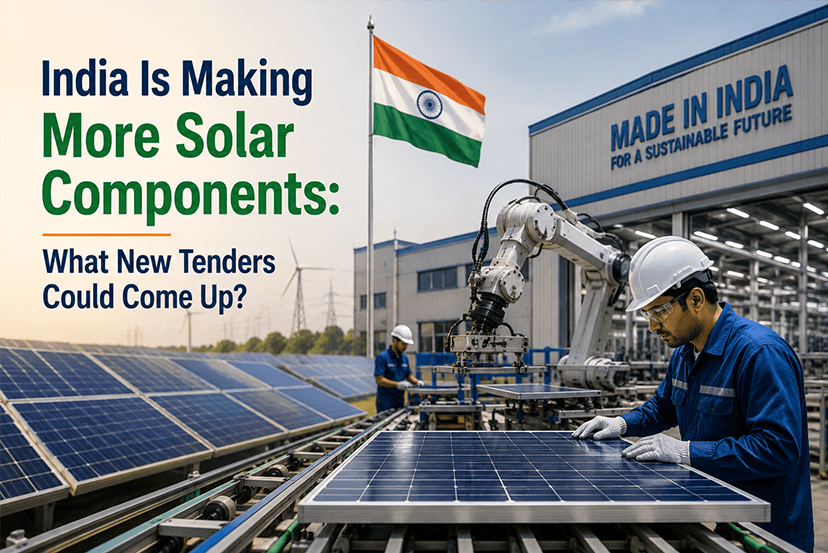
India is rapidly expanding its solar manufacturing capacity. The focus is no longer limited to installing solar panels; the country is also working to manufacture more of the components that go into a solar project.
This shift could open up new opportunities for solar manufacturers, equipment suppliers, EPC companies and contractors.
But what exactly could change in the tender market? And what types of solar tenders should businesses start watching? Let’s understand all in details!
Why Is India Expanding Solar Manufacturing?
India has added significant solar capacity in recent years, but several parts of the solar supply chain have traditionally depended on imports.
To reduce this dependence and build domestic manufacturing, the government has introduced initiatives such as the Production Linked Incentive (PLI) scheme for high-efficiency solar PV modules.
The scheme has an outlay of Rs. 24,000 crore and aims to support large-scale domestic manufacturing of solar PV modules and create a stronger local supply chain.
The government is also looking at strengthening upstream manufacturing, including critical materials such as polysilicon.
This means India’s solar opportunity could increasingly extend from raw materials and cells to modules, machinery and supporting equipment.
The details are from: Updated (03.08.2026) List-I under ALMM order for Solar PV Modules | MINISTRY OF NEW AND RENEWABLE ENERGY
What Solar Components Could See More Tender Opportunities?
As manufacturing capacity and solar installations grow, procurement demand could increase across several categories.
1. Solar Cells and Modules
- Solar PV modules will continue to be one of the biggest procurement categories.
- Government agencies, PSUs, renewable-energy organisations and project developers require modules for utility-scale projects, rooftop installations and other solar programmes.
- Businesses operating in this segment should also keep an eye on the Approved List of Models and Manufacturers (ALMM) because eligibility requirements can apply to government and government-assisted solar projects.
2. Solar Manufacturing Machinery
More solar factories mean more demand for manufacturing equipment. Future procurement could include:
- Solar cell and module manufacturing machinery
- Testing and quality-control equipment
- Production-line equipment
- Industrial automation systems
- Material-handling equipment
- Electrical and plant equipment
Suppliers may need to search for specific machinery, equipment or manufacturing-related requirements.
3. Polysilicon, Wafers and Other Upstream Materials
- India is also looking to strengthen the upstream part of the solar supply chain.
- If domestic manufacturing of polysilicon, wafers and other materials expands, procurement opportunities could eventually emerge for specialised equipment, production facilities and associated services.
- However, businesses should distinguish between government policy announcements and actual tenders. A proposed scheme does not necessarily mean that procurement has already started.
4. Inverters, Mounting Structures and Electrical Equipment
- Solar projects need much more than panels.
- Inverters, mounting structures, cables, transformers, junction boxes and other balance-of-system equipment are essential for installation.
- As solar deployment increases, tenders for these products and their installation can also increase.
- This is particularly useful for small and mid-sized suppliers that may not manufacture solar cells or modules but can supply supporting components.
What New Types of Solar Tenders Could Come Up?
India’s growing manufacturing ecosystem could create opportunities across different stages of the supply chain.
Solar Manufacturing Tenders
These may involve setting up or expanding solar manufacturing facilities, including machinery, plant equipment, engineering and installation.
Solar Component Supply Tenders
Government bodies and other organisations may procure modules, cells, inverters, mounting structures, cables and other components for specific projects.
Solar EPC Tenders
As more solar projects are developed, EPC tenders can cover engineering, procurement, construction, installation and commissioning.
Supply and Installation Tenders
Some contracts may combine product supply with transportation, installation, testing, commissioning and maintenance.
Factory Infrastructure Tenders
New solar manufacturing facilities also require civil works, electrical systems, warehouses, fire-safety systems, HVAC and material-handling infrastructure.
This means even businesses outside direct solar manufacturing can benefit from the expansion.
How Can Businesses Find These Solar Tenders?
One mistake suppliers often make is searching only for the term “solar tender.”
Tender requirements are usually published according to the product, service or project involved.
For example, a mounting-structure supplier may find more relevant opportunities by searching for:
- Solar mounting structure tenders
- Solar PV tenders
- Solar module tenders
- Solar inverter tenders
- Solar equipment tenders
- Solar EPC tenders
- Photovoltaic tenders
- Solar plant equipment tenders
- Solar manufacturing equipment tenders
It is also important to monitor procurement activity from central and state government departments, PSUs, renewable-energy agencies, DISCOMs and other public-sector organisations.
Searching multiple government portals every day can be time-consuming, especially when relevant opportunities are listed under different product or service categories. TenderShark helps businesses discover and track relevant solar tenders and others in one place, making it easier to identify opportunities that match their products, services and target markets.
What Should Suppliers Check Before Bidding?
Finding a tender is only half the job. Before submitting a bid, businesses should check whether they meet the tender requirements.
Pay particular attention to:
- Eligibility: Check turnover, experience, registrations and other qualification requirements.
- Technical specifications: Make sure your product or service meets every required specification.
- Previous experience: Some tenders require specific project or supply experience.
- EMD and tender fees: Check the amount, payment method and deadline.
- Delivery timeline: Ensure you can meet the required supply or completion schedule.
- Warranty and maintenance: Check whether installation, commissioning, warranty or after-sales support is included.
- Approved manufacturers or domestic-content requirements: These can be especially important in government-backed solar projects.
A tender may look relevant but still be unsuitable if your business does not meet its eligibility conditions.
How Can Suppliers Stay Ahead of Upcoming Opportunities?
The best time to prepare for a tender is before it is published.
Businesses should regularly track solar policies, new manufacturing investments, upcoming projects and procurement activity. These developments can provide early clues about where future demand may come from.
However, manually checking multiple government portals can be time-consuming.
Tender discovery platforms such as TenderShark can help businesses find relevant tender opportunities across categories and locations, making it easier to monitor new procurement requirements without checking multiple sources every day.
What Does India’s Solar Manufacturing Push Mean for Tender Opportunities?
India’s solar manufacturing expansion could create a much broader procurement ecosystem.
The opportunity is not limited to solar panels. It can extend to cells, wafers, polysilicon, manufacturing machinery, inverters, mounting structures, electrical equipment, EPC services and factory infrastructure.
For suppliers, the key is to look beyond today’s most common solar tenders and understand where new demand could emerge.
Track the manufacturing ecosystem, monitor the right tender categories and keep your bidding documents ready. As India’s domestic solar supply chain grows, businesses that prepare early can be better positioned to participate in the next wave of solar procurement opportunities.