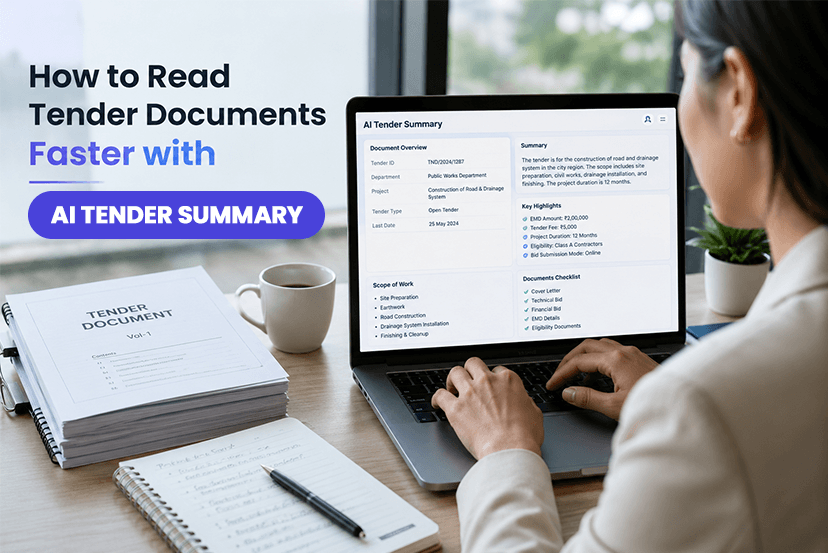
If you have ever spent a full day just to read a single tender document, you must know the frustration is real of not understanding the content. A 150 page tender buries eligibility criteria on one page, payment terms three annexures away and a penalty clause that no one reads until its too late. Reading does not mean reading faster, it should be where you need to pay attention exactly at what point.
Since the AI genre has become to popular in every Industry, you can also ease summerizing tender document effortless with the AI Tender Summary tool. Lets understand more about it through this guide. Let’s get into it.
Why Do Tender Documents Take So Long to Read?
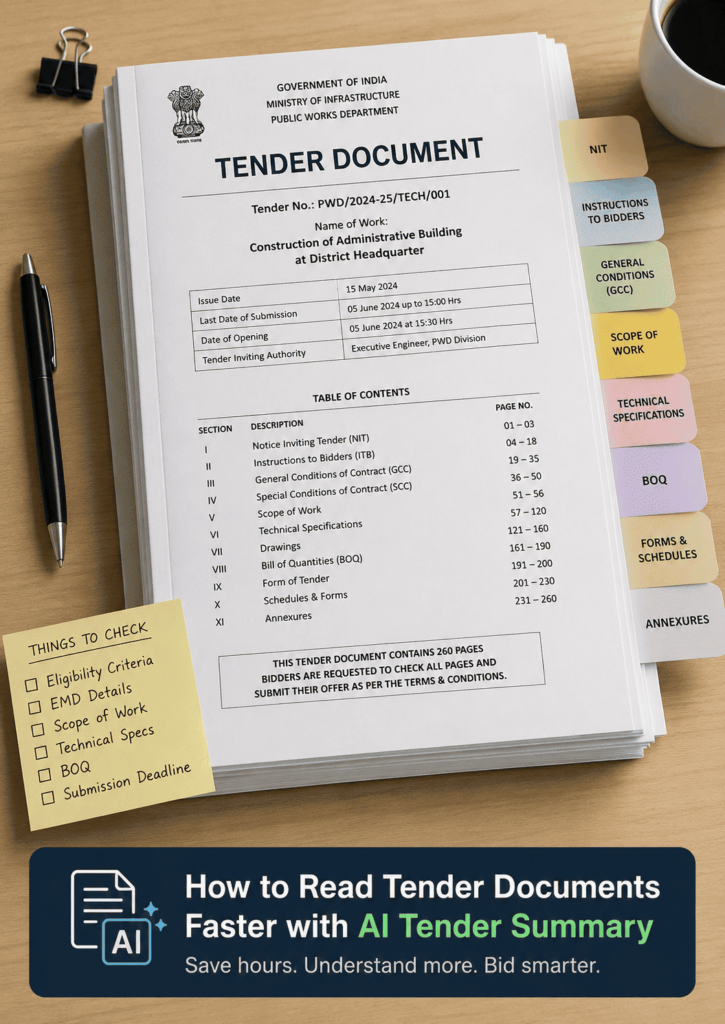
Indian tenders, government and enterprise alike, routinely run 80 to 250+ pages that are split across several documents that are set in separate Excel files.
- Notice Inviting Tender (NIT)
- Special Conditions of Contract (SCC)
- General Conditions of Contract (GCC)
- Technical Annexures
- Bill of Quantities
All this information in the Tender Document is not written for speed or formalities, it is written for legal completeness.
On top of that:
- Formats never match: Some tender release documents are clean, searchable PDFs. While others created scanned, skewed, low-res images from a regional office. Some come as Word docs with messy tables, others as Excel sheets. Each needs a different way of reading.
- Details: Eligibility might be on page 47, while technical specs are on page 90 and payment terms are in Annexure VII. So it becomes confusing.
- Clause Reference: As mentioned in Clause 3.2 sends you flipping back fifty pages. Two sections occasionally disagree outright, one says 10% advance payment, another says 15%.
- Corrigenda Changes the rule: A tender you read on day one might not match the tender you are bidding on by day ten.
- Volume Adds Up Fast: 15 to 20 tenders a week, each needs this level of scrutiny is not something a manual process can sustain.
Steps to Read Tender Documents For Quick Understanding
Here are the following steps that will help you get a better understanding of tender documents effortlessly-
Step 1: Stop Reading Top to Bottom
One of the most common issue that they read manually, like a book from start to finish and page by page. So most of what you need to do is go directly to the sections of eligibility, EMD, technical qualification, and key dates.
However, if you want to ease the hassle of reading tender documents, then AI Tender Summary by Tendershark is built around this exact instinct. You need to upload the tender: PDF, Word or Excel, scanned or clean, and our system maps the document as a whole rather than reading it start to finish.
Step 2: Let the System Handle Format Differences
In this, you should not have to manually convert a scanned PDF or reformat a messy Excel sheet before you can start reviewing it. AI tender summary’s OCR engine reads scanned, skewed and low resolution document that same way it reads a clean, text based PDF. This basically saves you from the most hassle process that takes too many hours.
Step 3: Important Clauses Are Hidden Across Multiple Documents
A tender notice or document does not include all the important information in one place. So, missing one clause can lead to submitting a non-compliant bid. You may find-
- Experience requirements on one page
- Financial turnover criteria elsewhere
- EMD exemptions in another document
- Delivery timelines inside the technical specifications
- Warranty obligations in special conditions
STEP 4: Human Errors Are Common
Mistakes can happen by anyone, even experienced professionals can overlook the details mentioned in the documents. The larger the document, the greater the risk of missing important information.
- Mandatory certifications
- Brand restrictions
- Product specifications
- Financial qualification criteria
- Performance security requirements
- Liquidated damages clauses
So in that case, with the AI Tender Summary tool, you can save time and energy to read the complete document.
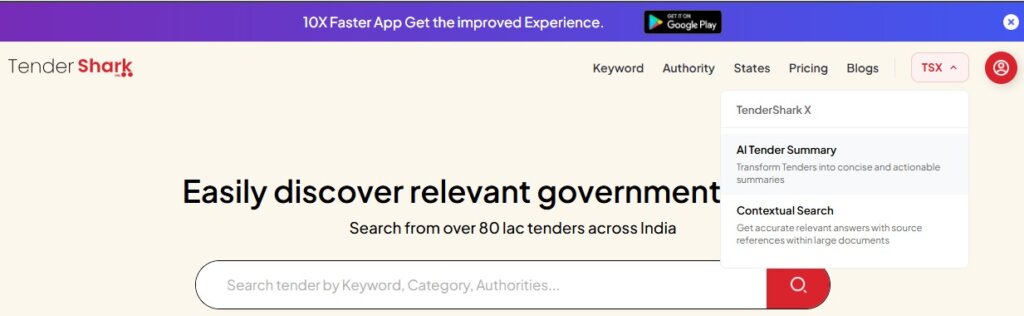
Introducing AI Tender Summary By TenderShark
AI Tender Summary is designed to simplify one of the most time consuming stags of the tendering process. It works to analyze lengthy tender documents and presents the most relevant information in a easy to understand format. So rather than spending hours searching through PDFs, users receive a concise summary highlighting the important details that are required to evaluate the opportunity.
Frequently Asked Questions (FAQs)
Q. Is reading a tender document faster miss important details?
Ans. No, if the speed comes from better structure rather than skimming. However, AI tender summary reads the entire document and also presents the essential details first.
Q. Can AI Tender Summary handle scanned or low-quality tender documents?
Ans. Yes. The OCR (Optical Character Recognition) engine is built to read scanned, skewed, and low-resolution PDFs.
Q. Will it work for my industry’s specific terminology?
Ans. AI Tender Summary is trained across 50+ industries, so it’s built to recognize sector specific language rather than applying a generic template to every tender.
Q. How much time does this actually save?
Ans. A manual review of a single 100+ page tender can take a full day. With AI Tender Summary, that same document produces a decision-ready summary in minutes — the time saved compounds fast when you’re reviewing 15-20 tenders a week.
Final Words
Reading tender documents faster should be carefully done without rushing. The document is specialized to mention the details that are required for the overall project if you ignore or miss any of the parts, it may lead to bid rejection. So in this guide, we have completed some of the important details that will help you complete the entire document reading process.