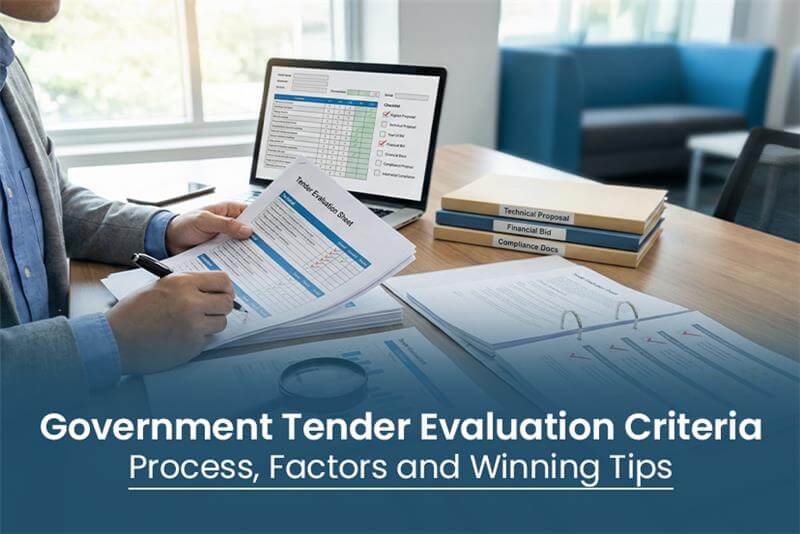
Many bidders get confused about the rejection even after offering the most competitive prices. The actual reason for most rejection in bidding completely relies on the process of “tender evaluation criteria”. Tender evaluation is the structured process through which procuring authorities assess bids based on predefined technical, financial, and eligibility parameters.
If you are thinking, ” Why evaluation matters for bidders, understanding how this evaluation works and aligning your bid accordingly increases your chances of winning. Well, in this guide, we have covered every detail related to the evaluation process in simple terms and tips on how to prepare strong bids that meet the tender’s expectations. So without delaying any longer, let’s get into it.
What Is Tender Evaluation?
The tender evaluation is the method used by government departments, PSUs, and private organizations to compare, score, and select the most suitable tender.
Basically, the evaluation process ensures that:
- Bidders’ eligibility and reliability.
- Bidder met the technical requirements completely.
- The quoted price is reasonable and justified for the project’s needs.
Note: By mentioning ” reasonable “, it means the quote price is completely “value for money”.
Importance of Understanding Tender Evaluation Before Bidding
Well, the following are the common reasons why understanding tender evaluation is important for bidders:
Reason for the Bid’s Failure
Many bidders fail because they don’t pay attention to the technical evaluation properly. Submit incomplete or non-compliant documents, and only focus on the pricing.
How Understanding Evaluation Criteria Helps?
If you know the evaluation criteria when preparing a bid, it will help you avoid disqualification at the early steps. Also, you can focus on high-sourcing sections of the bids and prepare realistic and competitive pricing.
How the Tender Evaluation Process Works: Step by Step
The following are the steps followed during the tender evaluation:
STEP 1: Pre-Qualification (PQ) or Eligibility Evaluation
It starts with a pre qualification check. Only bidders who meet the basic eligibility conditions will be suitable for further processing.
Common checks include:
- Company registration and legal compliance
- Turnover and financial capacity
- Past work experience in similar projects
- Required certifications and licenses
Tip: Even a small mismatch, like a wrong turnover year or a missing certificate, can lead to outright rejection.
STEP 2: Technical Evaluation
In this step, evaluators check how well your proposal meets the technical requirements. It includes:
- Compliance with technical specifications
- Methodology and execution plan
- Manpower, machinery, or infrastructure availability
- Quality standards and certifications
- Safety and compliance measures
Only technically qualified bidders are eligible for the next process, which is financial evaluation.
STEP 3: Financial Evaluation
As we mentioned, the financial bid is only opened for the technically qualified bidders, and the evaluation process includes:
Note: In QCBS, the final core is calculated by combining the technical score and the price score using fixed percentages.
STEP 4: Final Selection and Award
The last step is to select the most suitable tender for the project, in which the bidder with the highest overall score wins the contract.
The thing to note here is that the highest overall score does not necessarily mean the lowest price.
Understanding the Basic Tender Evaluation Criteria
First of all, tender documents clearly mention how the bids will be evaluated. So, here are the common criteria:
Work Experience and Past Performance
The first eligibility starts from the number of similar completed projects, the value, and the nature of previous work. Also, they required client completion certification as proof to showcase your specific experience.
Technical Compliance
It specifically includes:
- Adherence to specifications
- Complete company portfolio and registration details.
- Past work experience in a similar project.
- Technical approach or methodology.
- Manpower and equipment eligibility.
- Compliance documents.
- Certification and licenses.
Financial Strength
- Audited balance sheets
- Turnover and net worth
- Liquidity and solvency
Pricing
Now the pricing criteria includes the reasonable of quoted rates, break up of costs, and abnormally low or high bids.
Delivery and Execution Capability
Next, the bidder’s eligibility lies in the fact that they can deliver the project on time, so it includes the project timeline, resource deployment, and risk mitigation plan.
Common Tender Evaluation Models
The tender common evaluation models include:
- Least Cost Selection (LCS/ L1): In this model, the lowest priced bid wins, and is mainly used for basic goods or simple services.
- Quality and Cost Based Selection (QCBS): In this model, technical score and financial score both matter. For example, technical: 70%, and Financial: 30%. QCBS is mainly used for services like consultancy, IT, infrastructure, and related ones.
What Matters in Evaluation Beyond Price?
While the price is also not the priority, buyers also pay attention to the:
- Clear and well structured documentation.
- Consistency across forms and annexures.
- Proof based claims instead of generic statements.
- Confident bidders with reliable service and execution capability
How to Improve Your Chances of Winning Tenders
The following are ways to improve your chances to win the tender contract:
Read the Tender Document
You should not rely on the summary, pay attention to the special conditions, evaluation methodology, annexures, and formats.
Your Bid With Evaluation Percentage
To increase the technical percentages, make sure to properly maintain your documents and add proof and explanation.
Provide Proof Backed Information
Try to provide proof based information to avoid rejection, it shows the reliability and real based expertise.
100% Compliance
Comply with prescribed formats, upload documents in the correct file types, and use a checklist before the final submission.
Quote Realistic and Justifiable Prices
Don’t just focus on pricing the lowest because it leaves the suspense and red flags.
Final Thoughts
Being a bidder, understanding tender evaluation criteria will highly affect your chances of winning the bid. It shows that you rely on complete tender requirements and comply with standards. So, with a better understanding, bid confidently!